Filter products as a graph, not a checklist
Why P4M6, Gaussian, FAN, DDK, and HSAF should be traced as one product graph.
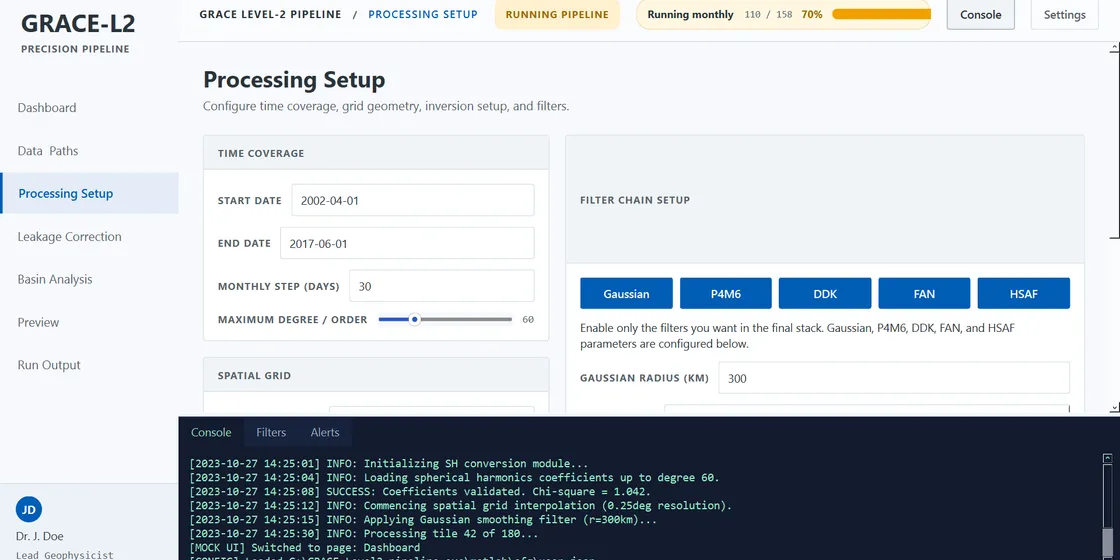
Why P4M6, Gaussian, FAN, DDK, and HSAF should be traced as one product graph.
GRACE Level-2 filtering is easiest to audit when it is treated as a graph. The corrected spherical harmonics are the shared source, and each product tag should preserve how it was derived.
P4M6 performs polynomial de-striping in the harmonic domain. GAUSS applies isotropic degree-domain smoothing. FAN uses anisotropic smoothing in degree-order space. DDK4 routes through the DDK filter family and must keep the requested DDK tag. HSAF is a grid-domain Hankel Spectrum Adaptive Filter, with P4M6 as the default upstream input.
That graph matters because repeated recomputation can hide routing mistakes. A requested DDK4 output should never silently fall back to Gaussian, and an HSAF output should always state which upstream grid it used.
For blog notes, the minimum useful record is the filter tag, the upstream source, the key parameters, and one validation check against the monthly product and stack outputs.